DORIS: A Life in the Greatest Generation
Sign up to be notified upon release to the public.

Born in 1920, Doris' remarkable memory spanned the Flapper era, Great Depression, WWII, and every decade until the end of her extraordinary life 103 years later.
Come with us on the adventure of a lifetime: following, coincidentally, in Amelia Earhardt's footsteps time and time again.
This is the story of a young girl reading adventures under the covers through the dark winters of Wisconsin, and making up her mind to live them for herself. In 1938, a stewardess was required to be a Registered Nurse. So that's what Doris set out to do, challenging as it was for her parents to pay for the specialized training during the Great Depression.
Because of Doris' slight stature, 5'0", under 100 pounds, she was hired for a commute line from Chicago to Cheyenne, Wyoming, where she was tall enough to hoist passengers' luggage into the bins above.
When her mother heard Doris' excited news she began to sob. "Please don't go. Promise me, Doris, you will not take this job."
"Why ever not, mother? This is what I have worked so hard for. You know I got my four-year degree in three years so I could start paying you back as soon as possible."
"Don't you know? I read in the paper maybe three months ago: a plane on that line crashed in the Rocky Mountains. Everyone was killed. I will not get a wink's sleep if you take this job. I will worry about you night and day."
Just to make sure, Doris headed to the library a couple of blocks away. The reference librarian found it for her within a short time. "Here it is. What dreadful business. Those poor people and their families."
So it was there in her beloved library, where Doris' lifelong dream had been hatched, that the news lay on the table before her that made the decision for her: she would not accept the position of stewardess that she had dreamt of for nearly a decade.
Doris began to look for work as nurse.
After a month-long search, she was offered a position at the Waukesha County Hospital, more than an hour north of her family home in Kenosha where her many aunts and uncles and 32 cousins lived.
"Your duties as Maternity Ward Nurse would be to tend and care for mothers and their infants. Would this be a position that would satisfy you?"
"Oh yes, indeed. This kind of care was covered in my recent training in Racine. I very much enjoyed it."
"Then you will begin on Monday at 11:00p.m., as Night Nurse in the Waukesha County Hospital Maternity Ward for the care of mothers and their newborn babies."
At report she was paired with a nurse with a year's experience in the ward, Mary Rodden. They became fast friends as Mary taught Doris how to bathe the babies, wrap them tightly in swaddling, lay them on the pushcart in proper order so as not to give the wrong baby to a doting mother, and check the vitals of the mothers as she nursed her infant.
Little did they know the adventure they would embark on together, as just three months later the startling news broke on the radio and in the EXTRA headlines:
"Oh no! I would never have imagined!
"Can there be a darker day?"
"There has to be an end to all this warring and fighting. This can't go on!"
Do you think we will retaliate?
"We can't just sit back. Look at these photos! They have to be stopped just as Germany does."
"Well, that means attacking them back, doesn't it."
"Can there be another way?"
"It seems war in the Pacific is inevitable now."
"Oh look, Mary. I think you are right. It says here they are asking nurses to join the war effort."
"Well, that certainly can't be us, Doris. Neither of us have any experience with ermergent trauma. They certainly won't be asking for help with newborn babies for the boys off to war."
"I suppose we're not qualified."
"You're barely out of nurses' training. The nurses who know how to tend bleeding injuries, broken bones, head injuries, bullet wounds, shrapnel... Oh, dear God..."
Mary broke down in tears, thinking of her enlisted brother and officer father fighting in Europe.
Doris lay her arm over Mary's shaking shoulders, and touched Mary's hands that were holding her head.
"We'll pray the rosary tonight for them. And say a second for all the people heading into harm's way."
"That will help, Doris."
She straigthened up. Her frame nearly twice the size of Doris. Mary grabbed her and they hugged tightly. Tears in both their eyes.
"I think you are right. If I can help I will, but I think perhaps we might be more in the way than able to help with such emergency situations. We would have to learn a lot on the job."
"What would Garbo do?"
"She would sign up!"
"Of course she would. So should we!"
"Let's see what the other nurses have to say. I'm sure they will be signing up and the effort will have all they need."
But the nurses that did have the experience bristled.
The Ward Nurse let them know: "I can not go. My twin girls have just started high school. My career is here where I have earned a good income these 27 years. I am in line for Chief Nurse when Flora retires in a year or two. If I leave I will lose that opportunity, that income and retirement. A war nurse makes one quarter of my salary. And when my brother returned from nursing duties in World War I, no one would hire him."
"Why ever not? He gained so much experience in urgency."
"Your guess is as good as mine. He was ready, willing and ever so able. But no one would have him."
"You know, that was the case with my Uncle Matias as well. When he came back, the Kenosha County Hospital where he had worked was asking the community for more nurses, but they rejected him."
"What did he end up doing?"
Doris bowed her head for a moment. Took a deep breath and raised it again.
"He didn't."
"How do you mean?"
Doris faught back tears as the Ward Nurse handed her a handkerchief.
He fell into drinking. He was very sad. When he was drinking my mother says he would talk about ending his life. They all told him to stop talking like that. But that's what he did, all right. My grandfather found him hanging from the rafters in the basement of my grandparents house where he lived. They were devastated. Großmutter Julia had to lay him out and prepare him. She was never the same."
"My dear child. I am so sorry for you and your family."
"Thank you, I didn't mean to be so..."
"No, child. It just tumbled out of you, as the truth can hardly be contained. As for my brother, he eventually found work as a maintenance man for an elementary school. Sometimes he helps with a wound on the play yard, but his real skills have not yet been put to good use."
"It all hardly makes any sense. It seems to me the situation ought to be in reverse. Hospitals should be begging people with that kind of experience to come help them."
"So you see the many reasons I can not go. But you are young, with your whole life ahead of you. When you return there will still be plenty of opportunity for you. The war won't last long and you will land fresh on your feet."
"But we're hardly qualified, what with taking care of babies," Mary spoke up.
"It's not that we don't want to go, we do! But we haven't worked in such emergencies and we might be a hindrance rather than a help."
"You both will do fine."
The decision was made for them.
The Emergency Room nurses and nurses in the acute section of the hospital all said the same.
"We can not go. You have your whole lives ahead of you. You don't have a husband or children. Doesn't it seem that you should be the ones to join up for duty?"
"It looks like it might be up to us, afterall," Mary determined.
"If the War Effort thinks I can be of service, I would be willing to go. I am not married, have no children. I did train in trauma and emergency, and I'm a fast learner."
"And our country needs us."
"My mother won't be happy."
"Mine neither, with both my brothers already away in Europe."
"They will worry, but they will also be proud of choice, don't you think?"
"My father is retired military. My brothers have joined the effort. We are a military family. I'm sure they never thought their girl would be able to participate. Well, let's show them what we can do!"
"I'm all for it!"
Doris raised her arm in the familiar gesture she learned as a guest Girl Scout to the local troop, declaring the Wisconsin state motto as Mary mirrored her, both declaring, Onward!
They took the train to Milwaukee their next day off, found the recruiting station, and with all the courage they could muster, signed a declaration that they were willing to join the War Effort as nurses dedicated to the cause.
Months passed.
"They've been saying on the radio they need nurses so badly. Why haven't they assigned us yet?"
"I read that article in Life magazine begging for women to sign up. We did. They didn't."
"Haven't. Will."
"Copesetic."
"Roger."
"AOK!"
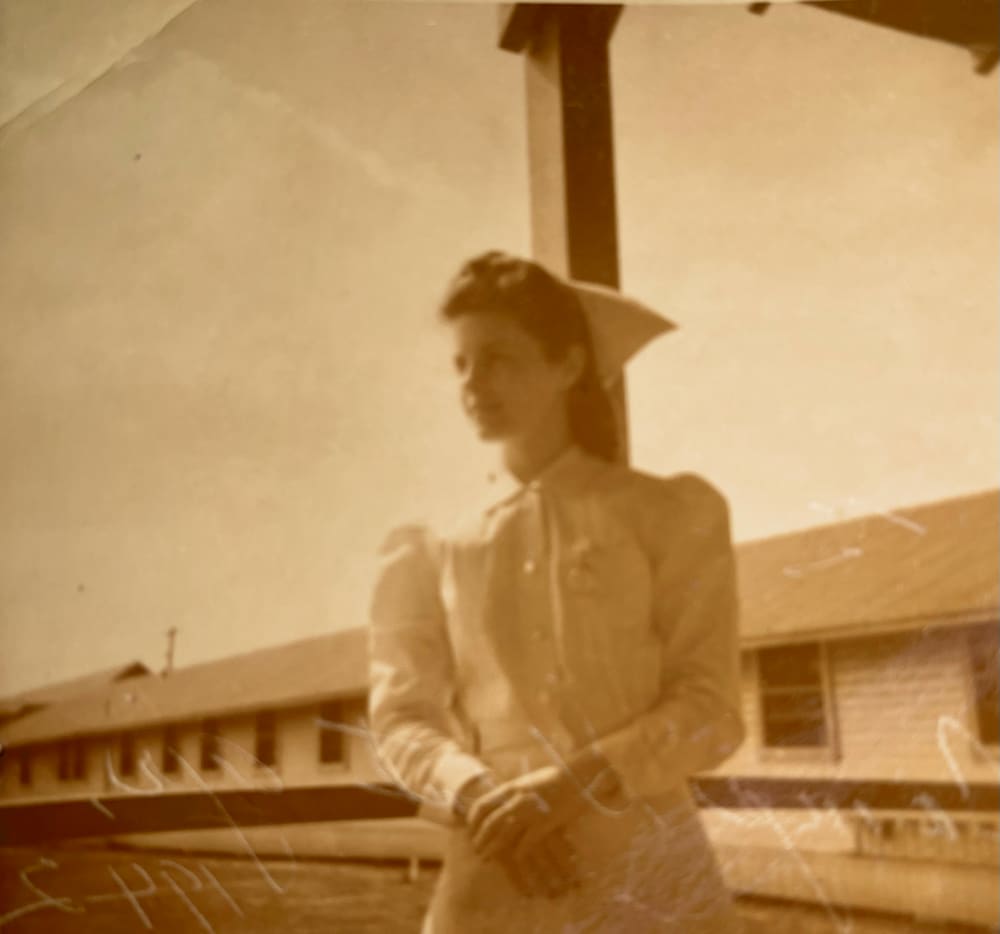
Five months after signing up in December 1941, the same month as the attack on Pearl Harbor, some mail was delivered to both at the hospital address they gave to be contacted.
Mary came rushing in to their shared room.
"I've been assigned! And my guess is you were, too."
Mary handed Doris the identical envelope made of thin "AERMAIL" tissue paper.
Seconds later Doris exclamed, "Camp Grant, Illinois!"
"What? Are you serious?"
"I would make this up?"
"No, it's just... that is my assignment as well. They put us together like we asked!"
"Never imagined that would happen."
"Doris! We are going to war!"
They hugged, laughed, danced around the tiny room for a bit, and the tears came.
"Mother will be crestfallen."
"She will be proud!"
"She will!"
"But, Illinois?"
"THIS is where they need us so badly?"
A week later, the two-hour long bus trip let them off in a remote area of southern Rockford, Illinois, at an enormous complex where they would begin their training for overseas duty: Camp Grant.
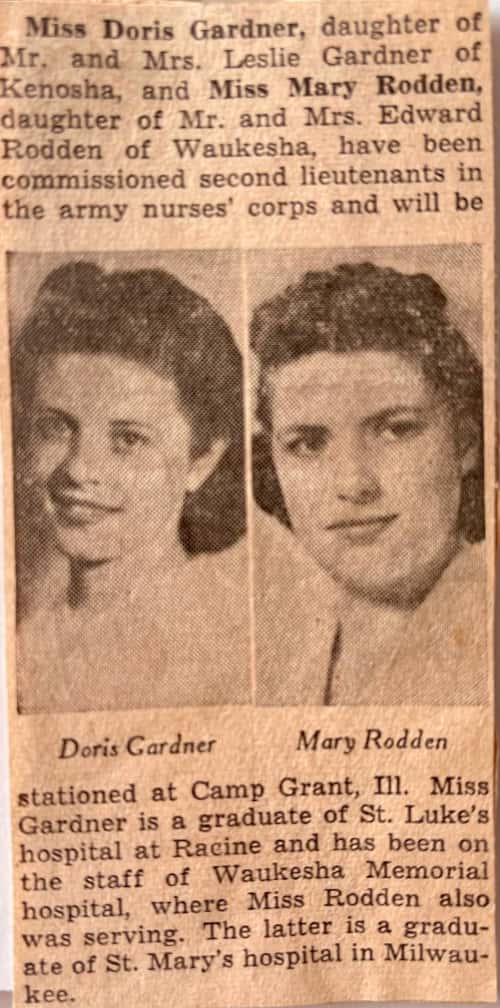
Mary and Doris were there for months. Finally, they begged Chief Nurse Crockett to help get them assigned.
Put me where you can most use me. I am young, I am energetic, I don't have a family to raise. Put me at the front.
And that's exactly what the Army Nurse Corps did. With her new-found specialty of broken bones and the maimed, after caring for mothers and babies in the Waukesha Public Hospital in Wisconsin, Doris and Mary were assigned together again for duty on the USS Comfort, the bright white ship adorned with blood-red crosses that would traverse the Pacific Theater of War many dozens of times along the Pacific ring.
The Comfort was to go into battle with D-Day invasions throughout the Pacific: 16 battles in all, including the great Battle for Okinawa, after which she was the target of a Kamikaze attack hours outside the bay.
But why did the Japanese go out of their way to target the brightly lit, Geneva Convention-protected ship making way all alone through the quiet and scintillant night waters of a full moon, striking only after the lights came on and all onboard thought they were safe?
Doris knew exactly why. She also knew the ship would be targeted. Before embarkation, and in secret, Doris was told that the U.S. had sunk a Japanese hospital ship in Subic Bay. The Japanese would retaliate with sinking the Comfort the first chance they could get. The Comfort was making ready to head straight into harm's way. Now will you please get off this ship? But she refused the harbor master she had dated who tried to get her to offboard:
These are my best friends. This is what I signed up for. Of course I'm not getting off this ship. We face death every moment. I will face it again. I will face it now, if that is the will of God….
Sign up to be notified upon release to the public.